L3Harris received roughly $955 million for 18 space vehicles; Sierra Space roughly $798 million for the other 18. Both on an accelerated schedule.
02 An accelerated tranche is a sub-tier qualification event, not just a headline number.Two primes standing up 18 space vehicles apiece on a compressed clock is when approved-supplier lists widen fastest.
03 A California propulsion start-up cleared an SSC hot-fire test on 11 July.Parabilis Space Technologies' DOTS module is a near-term in-state buyer of precision-machined propulsion parts.
04 Blue Origin confirmed it is seeking $10 billion in outside capital.A step-change target of 50 New Glenn launches a year by 2030 would reset booster and engine part rates across the supply base.
05 An AFRL hardware-integration IDIQ posted an even larger ceiling on 8 July — $499 million.
Notes from the co-founders
Two builders, thirty-six space vehicles, one accelerated schedule. The figure that matters to this readership is not the dollar value of the award; it is the word accelerated.
Compressed programs buy from suppliers who are already qualified, because there is no time left to qualify anyone new. That is an uncomfortable truth and a plain argument for completing the paperwork before an award exists rather than after it. Certification is not overhead. On a schedule like this one it is the whole distance between being on the bid and reading about it.
One capability card, from every member company, to Diego F. Padilla at diego@rakarinc.com, by Tuesday, 1 September 2026, 5:00 p.m. PT. One page: certifications held with expiry dates, processes performed in-house, maximum part envelope, current lead time, and one named federal or prime customer you are already qualified to. No brochure, no capabilities deck, no company history.
Cards received before the monthly AMA are reviewed on that call; cards arriving after it are worked in the cycle that follows. They are read against the solicitation language in Standing Watch, and where a relevant and consenting contact exists the cluster offers a named introduction. Cards not received are not matched. That is the entire mechanism.
$1.75 billion, 36 satellites, one week
The Space Development Agency split $1.75 billion between L3Harris and Sierra Space on 13 July 2026 to build 36 Accelerated Missile Defense Tranche 3 tracking satellites. Two builders, 18 space vehicles each, an accelerated schedule. It is the largest single satellite-build order of the period, and it lands on structures, harnesses and bracket suppliers before it lands anywhere else.
Compressed schedules generally favor already-qualified incumbents, but primes may add sources where incumbent capacity cannot meet rate or schedule. As of 14 July 2026, neither L3Harris nor Sierra Space had published a sub-tier sourcing plan for AMDT3. That gap, not the topline dollar figure, is what a California machine shop should be tracking.
Framing figure — Mary Golda Ross
“We were taking the theoretical and making it real.”
MARY GOLDA ROSS · LOCKHEED, BURBANK · 1942–1973Mary Golda Ross was born in Park Hill, Oklahoma, on 9 August 1908, a great-granddaughter of Cherokee Chief John Ross. She earned a bachelor's degree in mathematics from Northeastern State Teachers' College in 1928 and a master's degree in mathematics from Colorado State Teachers College in 1938, and taught mathematics and science in rural Oklahoma schools through the Depression. In 1941 she moved to California; in 1942 Lockheed Aircraft Corporation hired her in Burbank as a mathematician, initially working on the aerodynamics of the P-38 Lightning. Lockheed sent her to UCLA, where in 1949 she earned a professional certification in engineering — by most accounts the first Native American woman to do so. In 1952 she became a founding member of Lockheed's Advanced Development Program, the Skunk Works, then based in Burbank; she was the only woman among its original engineers. She is described by the Smithsonian National Air and Space Museum as "the first known Native American woman engineer." Skunk Works remained at Burbank until Lockheed relocated it to Air Force Plant 42 in Palmdale after 1989, so Ross's entire tenure on the program, to her retirement in 1973, was worked in Los Angeles County.
The Missile-Defense Build: what closed and opened, 8–14 July 2026
A $1.75 billion satellite award anchors the week. Four more signals sit around it.
One — SDA awards $1.75 billion for 36 accelerated missile-tracking satellites
The Space Development Agency awarded a combined $1.75 billion on 13 July 2026 to build 36 satellites under the Accelerated Missile Defense Tranche 3 program. L3Harris received roughly $955 million for 18 space vehicles; Sierra Space received roughly $798 million for the other 18. SDA announced the awards through the U.S. Space Force on 14 July 2026.
Thirty-six satellites split between two builders on an accelerated schedule is the largest single satellite-build order of the period covered by this issue. Accelerated schedules compress every stage behind the prime's own final assembly: structures, harnesses, brackets and optics mounts have to be sourced, qualified and delivered against a shorter clock than a standard tranche allows. That compression is what tends to widen an approved-supplier list, because the primes' alternative to qualifying additional sources is missing the delivery date.
As of 14 July 2026, neither company had published a sub-tier sourcing plan or a supplier day for AMDT3. Companies with AS9100-D certification, ITAR registration and flight-hardware heritage in structures, harness assemblies or precision brackets should treat the award date, not a public solicitation, as the moment to raise a hand with either prime's supply-chain organization.
Two — A California propulsion start-up clears an SSC hot-fire milestone
Parabilis Space Technologies, a California company, completed hot-fire testing of its Dense Orbital Transfer System (DOTS) — a 2U propulsion module — with Space Systems Command on 11 July 2026. SSC characterised the work as a novel application of heritage space propulsion technology. The company has said the module could fly in under a year once a launch partner is confirmed.
A propulsion module validated by SSC and sized to fly within a year makes Parabilis a potential near-term in-state buyer of precision-machined propulsion parts, valve bodies and small thruster components, if a funded flight and launch partner are secured — a company to track rather than a large contract to chase.
Three — A half-billion-dollar AFRL hardware-integration ceiling
Vantage Analytical was awarded an Air Force Research Laboratory space-systems and hardware-integration IDIQ on 8 July 2026, contract FA9453-26-D-X007, with a ceiling of $499,000,000. A ceiling at that scale, awarded as an integration vehicle rather than a single build, typically pulls in component-level fabrication and test subcontracts over its life rather than in one lump.
The same week, X-Bow Systems was awarded a Missile Defense Agency SBIR Phase II contract on 9 July 2026, contract HQ0860-26-C-E058, valued at $10,980,000, aimed explicitly at expanding solid-rocket-motor production beyond the current two-supplier base. It is the clearest industrial-base signal of the window for propulsion suppliers specifically: MDA is paying to create a third source, not just to fund research.
Four — Blue Origin confirms a $10 billion capital raise
Blue Origin confirmed on 8 July 2026, in a memo from chief executive Dave Limp, that it is seeking $10 billion in outside capital, reportedly in a round led by Coatue Management at a $130 billion valuation. In parallel, Blue Origin told NASA's Office of Inspector General that it is targeting up to 50 New Glenn launches a year by 2030 and more than 120 a year by 2035.
A step-change in launch cadence of that size is a step-change in booster and engine part rates across the entire domestic supply base, not only Blue Origin's own shops. Suppliers with cryogenic, structural or precision-machining capacity should model a 2030 demand curve now, not when the first supplier day is announced.
Five — Consolidation continues: MDA's second acquisition in three weeks
MDA Space agreed on 8 July 2026 to buy 70 percent of the French Earth-data analytics firm CLS for €567 million, its second acquisition inside three weeks after the 19 June agreement to buy Blue Canyon Technologies from RTX for $620 million. Consolidation at this pace may lead to supplier review or consolidation at the acquired companies, though no vendor-list changes have been announced. It is worth tracking even where the target is not itself a California supplier, because bus and component sourcing decisions typically get revisited after a change of ownership.
Separately, Voyager Technologies completed its acquisition of Astrobotic on 13 July 2026. Astrobotic's Griffin-1 lander shipped from Pittsburgh to NASA's Jet Propulsion Laboratory in Pasadena for environmental testing the same week, putting lunar-lander qualification work in California even as the acquiring company's name changes on the contract.
FIELD SIGNAL / ACCELERATED MISSILE DEFENSE TRANCHE 3“With these awards, SDA is accelerating the deployment of the Tracking Layer to provide the homeland, our deployed forces, and allies with global, persistent indications, detection, identification warning, tracking, and defense against advanced and evolving missile threats.”
— GURPARTAP “GP” SANDHOO, SPACE FORCE PORTFOLIO ACQUISITION EXECUTIVE FOR MISSILE WARNING AND TRACKING AND SDA DIRECTOR · 13 JULY 2026 · SPACE DEVELOPMENT AGENCY
Teaming Desk
This is our assessment of what an accelerated 36-satellite tranche is likely to pull through the supply chain, built from the categories of hardware SDA and its Tranche 3 primes have described publicly for tracking-layer space vehicles. It is not a sourcing list published by L3Harris or Sierra Space, and neither company has confirmed a sub-tier plan as of 14 July 2026. Members who perform any of this work should reply to this issue.
Likely in demand — satellite bus structures and brackets. Eighteen space vehicles per builder on an accelerated schedule is a repeat-build environment; structural machining and bracket fabrication tend to scale with unit count rather than program novelty.
Likely in demand — harness and cable assemblies. A 36-satellite production run at pace typically needs harness capacity beyond what a prime holds in-house, particularly under a compressed schedule.
Likely in demand — optics and sensor mounts. Tracking-layer satellites carry infrared and optical sensors for missile detection; mounting and alignment hardware is a precision-machining requirement independent of the sensor technology itself.
Likely in demand — thermal and composite panel work. Standard content on any satellite bus at this production scale.
Adjacent — solid-rocket-motor and propulsion components. The same week's X-Bow SBIR Phase II award signals a federal push to widen the motor-supplier base; castings, propellant-processing and inspection capacity sit behind that effort.
·Offered — qualification and certification support. Cluster members holding AS9100-D and ITAR registration able to serve as a qualified source for teams with a technology but no compliant production path.
·Offered — orbital transfer, hosted-payload and in-space propulsion capacity. See the member profile below.
Space Zero Gravity
Multinational space-technology developer operating from Provo, Utah and Tuxtla Gutiérrez, Chiapas, Mexico, designing and manufacturing CubeSats and nanosatellites to NASA methodology and delivering space-technology training.
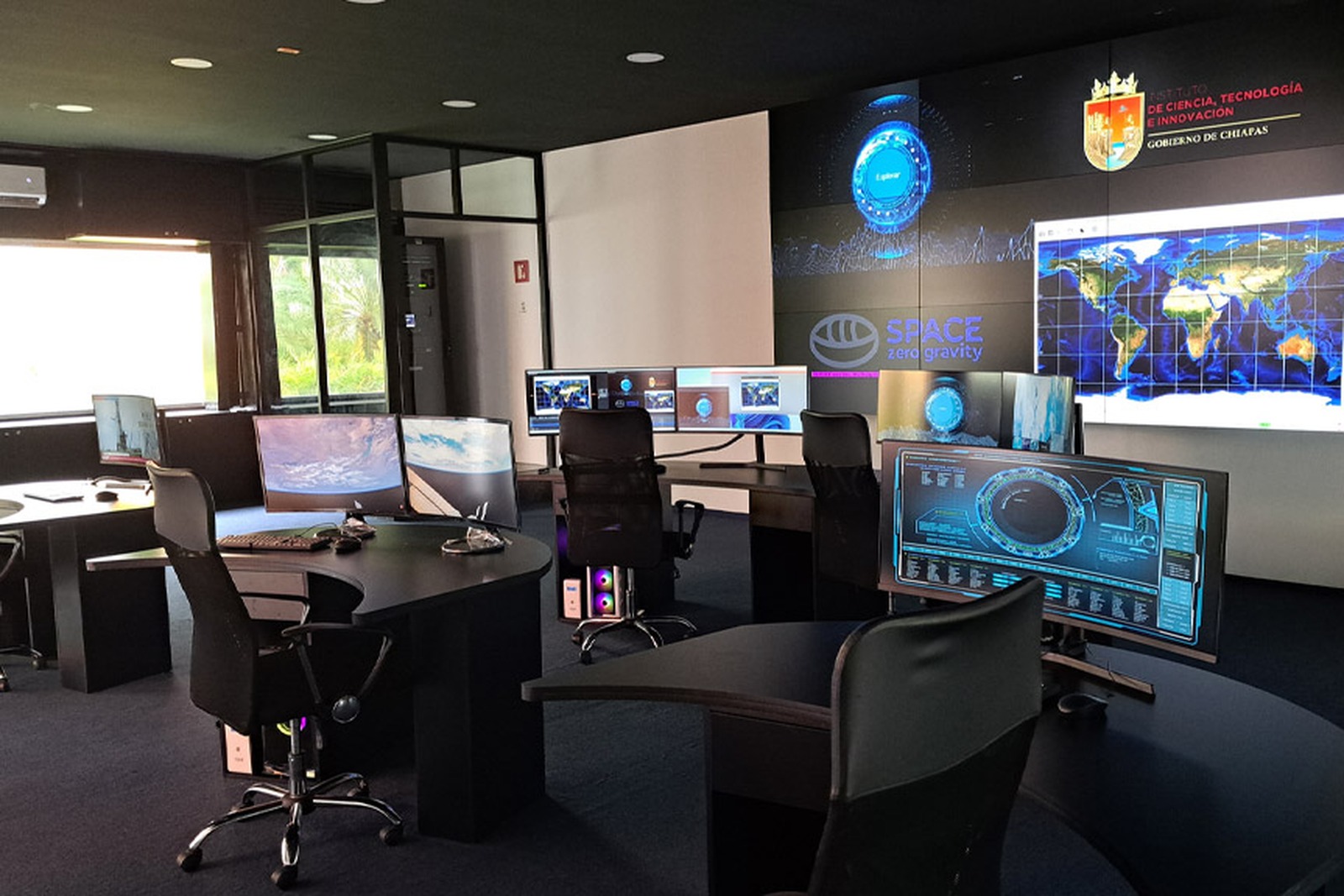
Space Zero Gravity presents itself on its own site as Space Zero Gravity México, and is described in Mexican Chamber of Deputies press material as “la empresa Space Zero Gravity”, a wholly Mexican, Chiapas-based company. It operates from two sites, Provo, Utah, and Tuxtla Gutiérrez, Chiapas, Mexico. The company designs and manufactures CubeSats and nanosatellites using NASA methodology, to a 10×10 cm unit standard weighing under 2 kg, combinable in 2, 3, 6, 12 and up to 24 units for low-Earth orbit, and plans multispectral cameras for vegetation-health and soil-moisture products. It also delivers space- and optical-technology training and NASA project-management courses, having previously run an online course called Capstone X. Development, manufacturing and testing of its first nanosatellite, along with a ground station for data processing, have been completed in Chiapas, alongside public training in antenna operation and satellite-data analysis. No corporate quality, security or set-aside certification is stated; individually, its technology-development director holds a BYU certificate in NASA-methodology nanosatellite development, and its projects director holds a radioactive-materials license from Mexico’s Secretaría de Energía.
The company was presented at a Chamber of Deputies press conference on May 27, 2024 by Deputy Jesús Roberto Briano Borunda as the firm that will launch and operate the first nanosatellite of Mexico’s southeast region, framed around national satellite sovereignty, with launch abroad and monitoring conducted from Mexico; the company is preparing proposals to participate under Mexico’s signature of the NASA Artemis Accords. Its founder, Ing. Luis Enrique Velasco Velázquez, led a mechanical-engineering team on NASA’s Mars 2020 Perseverance mission, participated in the creation of the Mexican Space Agency, and founded the Clúster Espacial of the Red de Mexicanos en el Exterior. State government support in Chiapas is documented in the same press material. Reported employment impact stands at more than 20 jobs created in Mexico and more than 100 people trained in Chiapas.
No 2026-dated development is established in the record. The most recent confirmed activity dates to September 12, 2025, when a collaboration agreement with Universidad Modelo in Mérida was reported, covering nanosatellite design, satellite-control software and professional training. Public activity has not been documented beyond that date.
Capital Flows
Where committed federal money and private capital moved between 8 and 14 July 2026, and what it buys downstream.
Bars are proportional. Only the SDA tranche is contracted money. The AFRL line is an IDIQ ceiling, the Blue Origin line is an outside-capital target rather than a closed round, and the MDA Space line is an announced acquisition price converted at the rate printed in this issue.
The Space Development Agency's $1.75 billion AMDT3 award on 13 July 2026 is the largest single figure of the week: roughly $955 million to L3Harris and roughly $798 million to Sierra Space, eighteen space vehicles each, on an accelerated production schedule (SpaceNews, U.S. Space Force). A same-week modification added $28,070,000 to SAIC's existing SDA Tranche 3 contract, FA2401-25-C-0005, dated 14 July 2026 (Department of War contract announcements).
Beneath the headline award, the week carried a string of smaller federal instruments that matter more to a sub-tier supplier than their size suggests. The Air Force Research Laboratory issued a space-systems and hardware-integration IDIQ to Vantage Analytical, contract FA9453-26-D-X007, with a $499,000,000 ceiling, on 8 July 2026 (DoD contract announcements). The Missile Defense Agency awarded X-Bow Systems an SBIR Phase II solid-rocket-motor contract, HQ0860-26-C-E058, worth $10,980,000, on 9 July 2026, aimed at qualifying a third motor source (DoD contract announcements). The same notice carried an $11,050,000 space data-networking award to RTX's BBN Technologies unit. On 10 July 2026, Pivotal Space's existing contract FA8821-25-D-B001 was raised by $93,000,000 to a $100,000,000 ceiling (DoD contract announcements).
Private capital moved at a larger scale than any single federal award. Blue Origin confirmed on 8 July 2026 that it is seeking $10 billion in outside capital in a round led by Coatue at a reported $130 billion valuation, targeting fifty New Glenn launches a year by 2030 and more than 120 a year by 2035 (SpaceNews). MDA Space agreed the same day to acquire 70 percent of the French Earth-data analytics firm CLS for €567 million (SpaceNews). Venus Aerospace closed a $91 million Series B on 8 July 2026 to scale rotating-detonation rocket-engine production (SpaceNews).
On 13 July 2026, Voyager Technologies completed its acquisition of Astrobotic: $162 million in cash and stock plus assumption of $9 million in debt, with up to $129 million in additional earnouts. Astrobotic's Griffin-1 lander shipped the same day to NASA's Jet Propulsion Laboratory in Pasadena for environmental testing (SpaceNews). Flexell Space raised a $20 million Series A on 13 July 2026 (SpaceNews).
Tuesday, 1 September 2026
11:00 AM Pacific · 45 minutes · in person & virtual
Ask Me Anything. Direct engagement with the cluster co-founders on programs, teaming, and the California space supply chain. Open to entrepreneurs, engineers, researchers, and anyone working in or near the space economy.
1680 Universe Cir
Oxnard, California 93033
Cadence · first Tuesday of every month · 11:00 AM Pacific · recurring. Capability cards submitted by 5:00 PM Pacific the day of the call are worked in the cycle that follows. By-Laws & Capability Statement at spacereturn.org.
Build the cluster with us.
SpaceReturn///// the California Space Cluster is a membership body of California space and aerospace manufacturers, operators, test facilities and service providers. Membership enquiries: diego@rakarinc.com.
Linked public record — procurement and capital
- AMDT3 award, 36 space vehicles, $1.75B — SpaceNews
- AMDT3 official award announcement, 14 July 2026 — U.S. Space Force
- AMDT3 additional coverage — DefenseScoop
- SAIC Tranche 3 modification, FA2401-25-C-0005, 14 July 2026 — DoD contract announcements
- Vantage Analytical AFRL IDIQ, FA9453-26-D-X007, 8 July 2026 — DoD contract announcements
- X-Bow Systems / RTX BBN Technologies awards, 9 July 2026 — DoD contract announcements
- Pivotal Space modification, FA8821-25-D-B001, 10 July 2026 — DoD contract announcements
- NASA CLDC draft RFP comment-deadline extension — SAM.gov
- NASA CLDC draft RFP posting — SAM.gov
- ESSCA II, Solicitation 80MSFC26R0002 — SAM.gov
- Kronos Family of Systems CSO, FA8806-26-S-0001 — SAM.gov
- AFTC rocket-based combined-cycle propulsion RFI, RFIFA930026R0001 — SAM.gov
- Blue Origin $10B outside-capital raise — SpaceNews
- MDA Space acquisition of 70% of CLS, €567M — SpaceNews
- Voyager completes Astrobotic acquisition, 13 July 2026 — SpaceNews
- Space Force procurement reorganisation, nine Portfolio Acquisition Executives — SpaceNews
- Parabilis Space Technologies DOTS 2U hot-fire test, 11 July 2026 — SpaceNews
Method & colophon
Figures are drawn from primary records wherever a primary record exists — a solicitation notice, an appropriations document, a regulatory filing or an official release — and from identified secondary reporting where one does not. Every source is linked in the column alongside. Where two sources disagree, the disagreement is printed rather than resolved silently. Conclusions the record does not itself state are hedged, or marked as cluster assessment.
- Published by
- SpaceReturn///// The California Space Cluster
- Co-publishers
- Theresa Padilla-Chaparro · Diego Padilla
- Compiled from
- Primary records and identified reporting, linked alongside
- Member contributions
- None in this issue — submissions welcome
- Corrections
- info@spacereturn.org
- Dateline
- Saturday, 11 July 2026 · Oxnard, California
Linked public record — framing figure and capability profile
- Mary Golda Ross biography — Wikipedia
- “Mary G. Ross: Aerospace Engineer” — Smithsonian National Air and Space Museum
- Skunk Works history and site chronology — Wikipedia
- Mary Golda Ross and Skunk Works — The National WWII Museum
- Mary G. Ross planned missions to Mars, from Burbank — LAist
- Mary Golda Ross biography — Encyclopaedia Britannica
- Air Force Plant 42 facility history, “January 8, 1942: Palmdale Airport Becomes Plant 42” — Air Force Test Center
Member profile — Momentus Inc.
- Momentus Inc. Form S-3, 2026 — SEC EDGAR — source
- FY2025 Form 10-K filing index — SEC EDGAR — source
- Balance sheet and mission update, 8 June 2026 — Business Wire — source
- Investor presentation — backlog, forecast and SHIELD ceiling — source
- January 2026 government payments, 12 February 2026 — source
Use this briefing.
Forward it to one supplier who is not yet a member.
Member capability card. Standing module. Members may submit or update a capability card at any time; the one-page format set out above is the current standard.
Mailing address: *|LIST:ADDRESS|*
The Space Observer and its contents are sponsored by Rakar, Incorporated. To place advertising or sponsor a section, contact marketing@rakarinc.com. Public-record items are linked to open agency or publisher postings. Member-private items require express permission before publication. This briefing is informational only and is not legal, investment, export-control or procurement advice; verify all deadlines, eligibility and solicitation terms with the issuing authority before acting. © 2026 SpaceReturn///// The California Space Cluster.